

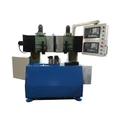
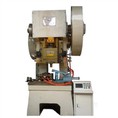
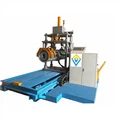
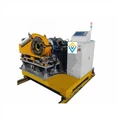
Plate Leveling Machine
Plate leveling machines can be operated manually or automatically, depending on their complexity and level of automation. Operators manually feed plates into manual equipment and alter the straightening process parameters in manual machines. automatic machines frequently use modern controls, sensors, and computerized systems to automate the feeding, straightening, and amending procedures.Plate leveling machines may work with an array of plate sizes, thicknesses, and materials, including steel, aluminum, stainless steel, and other metals. They are capable of straightening plates with high accuracy and repeatability, ensuring constant quality and dimensional accuracy.
Precision in Straightening
Plate leveling machines are designed to straighten plates correctly and with great precision. They are geared towards successfully eliminating residual stresses, deformations, and warping from metal plates, resulting in a flat and even surface.
Improved Material Properties
The plate leveling machine boosts material qualities by leveling metal plates, reducing internal stress, and improving structural integrity. It enhances strength and durability, perfect for applications that require flatness and precise dimensions.
Enhanced Production
Using a plate leveling machine can considerably increase productivity in manufacturing processes. It eliminates the need for time-consuming and labor-intensive hand straightening by straightening plates easily and effectively. This allows for faster manufacturing cycles and reduced lead times.
Improved Quality Control
Plate leveling machines ensure consistent and uniform straightening, guaranteeing constant quality and dimensional accuracy, minimizing rejection chances, and facilitating inspection and quality control in manufacturing.
Adaptability
Plate leveling machines are versatile as they can handle a wide range of plate sizes, thicknesses, and materials. They have got you covered with their versatility in straightening different metals like steel, aluminum, stainless steel plates, and other metals.
Cost-Effective
By reducing labor costs, eliminating the necessity for manual straightening, or removing outsourcing, plate straightening devices provide long-term cost advantages. By reusing damaged plates, they reduce material waste and enhance material consumption.
Security and Ergonomics
The manual plate straightening process is physically laborious and potentially dangerous. The risk of injuries associated with the handling of heavy-shaped plates is decreased by using a plate straightening machine. It also offers operators a safer working environment.
Adjustability and Flexibility
Plate leveling machines often come with settings that may be modified, allowing users to tailor the straightening procedure to meet particular needs. They can achieve suitable flatness and surface uniformity for many plate applications thanks to their versatility.


Why Choose Us
Customer Service
We firmly believe that we offer THE BEST customer support in the industry and it is our ongoing goal to continually improve on our services. As an independently owned and operated business, we are able to provide the most accommodating service possible.
Advanced equipment
We take strong measures to ensure that we use the highest quality equipment in the industry and that our equipment is regularly and meticulously maintained.
Rich experience
Has a long-standing reputation in the industry, which makes it stand out from its competitors. With over many years of experience, they have developed the skills necessary to meet their clients' needs.
Efficient and convenient
The company has established marketing networks around the world to provide high-quality services to customers in an efficient and convenient manner.
Quality assurance
In terms of quality assurance, the company strictly follows the standards and norms of the industry quality system. Adopt industry-leading testing equipment to ensure product quality and good reputation.
State-of-the-art technology
We use the latest technology and tools to deliver high quality services. Our team is well-versed in the and advancements in technology and uses them to provide the best results.
Research and simulation of the sheet leveling machine manufacturing capabilities
One of the main tasks to determine the technological settings of the sheet leveling machine (leveler) is to identify the maximum roll overlap. In the well-known works on the study of sheet metal-roll leveling, the overlaps are set on the basis of experimental data, which is applicable for the leveling sheets from material with the 800-MPa yield strength. But for materials with a higher yield strength, additional research is required. The purpose of this work is to establish criteria affecting the maximum allowable overlap for the working rolls by the leveler and to determine the dependencies for the most rational working roll adjustment. When solving the set tasks, developed by the authors, an analytical mathematical model of the leveling process was used as an objective function that allows to determine the energy-power characteristics and the sheet curvature after leveling, depending on the individual settings of the leveler rolls. Within the framework of studies, an algorithm of a mathematical model was developed that allows to determine the leveler technological settings necessary for correcting the longitudinal curvature and comes down to determining the aligning coordinates for each of the movable rolls depending on the known characteristics of the metal being processed, the leveler geometric parameters, and the permissible value of the sheet residual curvature after leveling. In consequence of studying the influence of the working roll setup on the sheet metal-roll quality during leveling on a multi-roll leveling machine, the laws for the rational rolls positioning were established. The linear and sinusoidal laws were identified as optimal ones. Boundary factors were also established as affecting the maximum overlap of the rolls. These factors included the condition of the pickup and the condition of the roll strength. Using the example of implementing the developed finite element model of the sheet leveling process at the leveler of NKMZ (Ukraine), it was found that the pickup condition has a dominant influence when leveling sheets with a thickness of less than 6 mm, and with larger thicknesses the condition of the roll strength is prevailing. With a decrease in the yield strength of the material or the width of the sheets, this ratio will be redistributed toward the pickup condition.
Prepare the adjustment of the precision leveling machine. Cut the coil material into pieces of material about 1 meter long, prepare to use in adjusting the leveling machine, and connect the external power supply of the leveling machine to open the leveling machine.
Appropriately raise the presser spring of the leveling machine, and prepare to feed the cut material into the leveling machine for trial preparation.
leveling machine, and then adjust the operation button on the control box on the electric control box of the leveling machine to the manual control position, and then press the inch. Rotate forward so that the material to be leveled slowly passes through the leveler until the material exits the discharge port.
Evenly adjust the sizing adjustment hand wheel of the leveling machine and press down the material until the material cannot be pulled gently.
Press the inching forward on the electric control box to make the rear part of the material pass through the leveling machine. If the arc of the material after passing the leveling machine is opposite to the original arc, it means that the leveling handle is pressed too much, and it needs to be appropriate to raise the hand wheel.
After using the hand wheel to adjust the height, press the inching forward on the electric control box to test the material again. If the material curvature after the trial is still the direction of the original arc, the arc is much smaller , indicating that the scoring adjustment hand wheel is too much, it needs to be lowered a little.
In the process of leveling and rectification, the material is inclined to one side. This situation is because the pressure at both ends of the leveling roller is inconsistent. The leveling handle should be adjusted so that the leveling roller on one side of the running material is upward to reduce the friction with the material.

Applications of Plate Leveling Machines
Steel Production
Plate leveling machinery is widely used in steel mills and steel fabrication facilities that produce steel. Before additional processing, such as cutting, welding, or rolling, they straighten steel plates to ensure superior flatness and dimensional accuracy for subsequent operations.
Metal Production
Plate leveling machines are essential in metal fabrication shops where flat plates are needed for building structures and machinery. They work by aligning and removing deformations from metal plates of different sizes and thicknesses, ensuring precise results.
Shipbuilding Industries
Metal plates used for creating ship hulls, decks, and other components are straightened using plate leveling machines in the shipbuilding industry. These devices ensure the plates adhere to strict design parameters and meet the flatness requirements.
Aviation Industry
In the aerospace sector, plate straightening machines are used for manufacturing structural panels, wings, and fuselages for airplanes. The uniformity and dimensional accuracy needed for high-performance aerospace applications are made possible by these machines.
Automotive Manufacturing Industry
Body panels, chassis pieces, and other metal parts are produced in automotive manufacturing plants using plate straightening equipment. These machines assure uniform flatness by straightening the plates, which is essential for maintaining the required fit and polish of automotive parts.
Construction Industry
Plate leveling machines are used in the construction sector to create flat and straight metal plates used in building constructions, bridges, and infrastructure projects. These tools assist in achieving the dimensional accuracy and surface quality essential for construction.
Manufacturing of Heavy Machineries
Plate leveling machines are used in the manufacturing of heavy equipment and machinery like cranes, excavators, and mining machinery. They guarantee the flatness and alignment of huge, heavy plates, which are essential for the efficacy and security of these devices.
Energy Sector
In the energy industry, plate leveling machines are used to manufacture parts for power plants, renewable energy installations, and oil and gas facilities. They are used to straighten the plates that will eventually be made into crucial pieces like boilers, heat exchangers, turbine parts, and others.
How Plate Leveling Machine Works
Plate leveling machines are essential tools in the manufacturing industry, especially in metal fabrication. These machines are designed to flatten and straighten metal plates, ensuring that they meet the required standards for quality and precision.
The process of how a plate leveling machine works is quite fascinating. It begins with the placement of the metal plate onto the machine's conveyor belt. As the plate moves through the machine, it passes through a series of rollers that apply pressure to the surface of the plate. These rollers are strategically positioned to exert pressure in different directions, allowing them to effectively flatten any imperfections in the metal.
Along with the rollers, plate leveling machines also utilize hydraulic systems to control the amount of pressure applied to the plate. This ensures that the plate is leveled evenly across its entire surface, resulting in a smooth and uniform finish.
Types of Plate Leveling Machine
Precision levellers
These are high-precision machines that are capable of flattening metal sheets to within a few thousandths of an inch. They are typically used in applications where high levels of precision and accuracy are required, such as in the production of aerospace and automotive components.
Cut-to-length levellers
These machines are designed to cut metal sheets to a precise length while simultaneously flattening and levelling them. They are commonly used in the production of metal roofing and siding materials.
Coil-to-coil levellers
These machines are used to flatten and level metal coils, rather than individual sheets. They are commonly used in the production of metal strip products such as automotive trim and appliance components.
Heavy-duty levellers
These machines are designed to handle thick, heavy-duty metal plates and sheets. They are commonly used in the production of construction materials such as steel beams and plates.
Choosing the Right Plate Leveling Machine
When it comes to choosing the right plate leveling machine, there are several factors to consider to ensure you are making the best decision for your needs. Plate leveling machines are essential for industries that rely on precision and accuracy in their manufacturing processes. These machines help to ensure that metal plates are leveled and flattened to the required specifications, resulting in high-quality finished products.
One of the most important factors to consider when choosing a plate leveling machine is the size and capacity of the machine. You need to determine the maximum size and thickness of the plates that you will be working with to ensure that the machine can handle your requirements. Additionally, consider the speed and accuracy of the machine, as these factors can greatly impact the efficiency of your operations.
Another important consideration is the type of leveling technology used in the machine. Some machines use hydraulic systems, while others use mechanical systems. Each type of technology has its own advantages and disadvantages, so it's important to choose the one that best suits your specific needs.
In addition to size, capacity, and leveling technology, you should also consider the overall durability and reliability of the machine. Look for a machine that is built to last and can withstand the demands of your industry. Additionally, consider the ease of maintenance and any potential service or support options that are available.
Our Factory
Guangzhou Deya Machinery Manufacturing Co. Ltd, national high-tech enterprise, is a science and technology service enterprises focusing on PHC pipe pile products industry with the core of technological innovation + service + big data application. Deya company provides the overall solution of intelligent production of cement products to customers, including the research and development of professional intelligent equipment, the cultivation of professional talents and provision of site management solutions, and so on.


Certifications


FAQ
We're professional plate leveling machine manufacturers and suppliers in China, specialized in providing high quality customized service. We warmly welcome you to buy or wholesale discount plate leveling machine in stock here from our factory. Good service and low price are available.
Flange Rotary Leveling Machine for PHC Pipe Pile